 Sunlite Systems Pvt. Ltd.

Optoma Distributor in India for Business, Education and Home Theater Projectors
What Buyers Mean When They Search for an "Optoma Distributor in India"
India is a vast and logistically varied market, and when a school, corporate facilities team, or government office searches for an Optoma distributor in India, the underlying question is rarely just "who sells this brand." It's a question about reach, reliability, and process — can this distributor deliver consistent projection equipment to a campus in one state and an auditorium in another, can they handle a formal government tender, and will they still answer the phone a year after the sale if a lamp or a unit needs attention?
Optoma's projector range spans home theater units through business and education-grade projectors up to high-brightness laser models suited to large auditoriums, which means the buyer profile searching for a distributor is equally broad — a school procuring classroom projectors, a corporate office fitting out presentation rooms, an event or auditorium operator needing high-brightness laser projection for large-venue visibility. A capable national distributor has to serve all of these use cases without treating any of them as an afterthought.
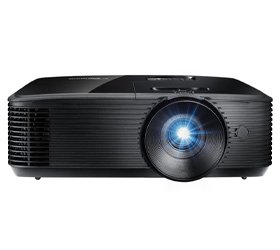
Sunlite Systems Pvt Ltd, headquartered in Ghaziabad, Uttar Pradesh, operates as exactly this kind of distributor — a GeM-registered vendor serving government tenders alongside direct B2B and institutional sales across sectors that include education, corporate, healthcare, manufacturing, hospitality, and auditoriums, with an online storefront that gives visibility into the broader catalogue as well.
Why Authorized Distribution Matters for Projection Equipment
Projectors are optical and electronic instruments with components — lamps or laser light sources, imaging chips, cooling systems — that are engineered to precise specifications and that degrade or fail in predictable, serviceable ways when genuine. Equipment sourced through unauthorized import channels or unverifiable resellers strips away the ability to get manufacturer-recognised servicing when something inevitably needs attention, whether that's a replacement part, a firmware update, or simply expert guidance on brightness and placement for a specific room.
For institutional buyers, this isn't a theoretical concern. A classroom projector or an auditorium laser projector represents a genuine capital investment expected to remain in service for years, often across multiple academic sessions or event calendars. If the unit was sourced through an undocumented channel, the buyer has no real recourse when service is needed — no traceable link back to the manufacturer's support and warranty structure. An authorized distributor closes that gap by ensuring every unit moves through a documented chain from manufacturer to buyer.
There is also a straightforward compliance angle for government and institutional buyers specifically. Audit and finance departments in schools, hospitals, and government offices routinely need to verify that capital equipment was procured through a legitimate, traceable, GST-compliant channel. Buying through a genuine Optoma distributor in India with GeM registration gives institutional buyers exactly the documentation trail their own internal processes require.
Distributor Logistics: What Serious Buyers Should Expect
National distribution of projection equipment is fundamentally a logistics problem as much as a sales relationship. A distributor serving India's institutional market needs to manage delivery across widely varying geographies — metro corporate offices, semi-urban school campuses, and everything in between — while keeping product knowledge consistent across every use case, from a compact home-theater-style unit to a high-brightness laser projector destined for a thousand-seat auditorium.
For buyers, this means the distributor relationship should start with a genuine scoping conversation: what is the room size and ambient light condition, is the installation permanent or portable, how many units are needed and across how many sites, and what is the realistic delivery and installation timeline given the buyer's own construction or academic calendar. A distributor who skips this step and simply quotes a unit price on request is generally not equipped to handle anything beyond a single small order.
Distribution logistics also has to account for after-sales serviceability — lamp or light-source replacement, technical support for setup and calibration, and the ability to source replacement units quickly if something in a critical space like an auditorium or a hospital conference room fails. A genuine national distributor plans its stock and support structure around these realistic service needs rather than treating delivery as the end of the relationship.
Finally, for larger institutional rollouts spanning multiple campuses or venues, phased delivery matters as much as it does for any other bulk equipment category. A distributor who understands institutional buying patterns will plan shipments around the buyer's actual rollout schedule — building by building, site by site — rather than insisting on a single bulk delivery that creates storage and handling headaches.
Where Optoma Projectors Are Deployed Across Sectors
Education is one of the largest and steadiest markets for projection equipment in India. Classrooms need business and education-grade projectors that perform reliably under everyday classroom lighting conditions and stand up to years of daily use, while larger institutional auditoriums within the same campus — for assemblies, seminars, and events — often call for higher-brightness units capable of covering a much larger room. Schools and colleges rolling out projection equipment across multiple classrooms and halls represent exactly the kind of multi-unit, phased order that a genuine distributor relationship is built to support.
Corporate presentation rooms form a second major use case. Offices across sectors rely on business-grade projectors for meeting rooms, town halls, and client presentation spaces, where consistent image quality and dependable day-to-day operation matter more than any single specification. Facilities teams outfitting a corporate office often standardise on one projector line across every room for simplicity of maintenance and support.
Large-venue auditoriums and event spaces represent a third distinct category, where Optoma's high-brightness laser projectors are suited to the scale and visibility demands of big rooms — government auditoriums, institutional event halls, and hospitality venues hosting conferences or large gatherings all fall into this bracket. These installations tend to be higher-stakes technically, since a single central projection system serving a large audience has far less tolerance for downtime than a single classroom unit would.
The GeM Tender Route for Projector Procurement
A significant share of India's institutional projector demand — government schools, PSU training centres, government auditoriums, and public healthcare facilities — is procured through the Government e-Marketplace rather than through open-market negotiation. Sunlite Systems' GeM registration allows these institutions to procure Optoma projectors through the same platform and purchase-order process they use for other equipment categories, which removes a substantial amount of procedural friction compared to sourcing from a distributor without GeM listing.
For government buyers specifically, working through a GeM-registered distributor also satisfies the documentation and compliance expectations built into public procurement rules — verifiable vendor registration, transparent pricing structures, and a traceable supply chain are effectively prerequisites for government tender participation, and a genuine distributor relationship delivers all three by default.
Alongside formal GeM tenders, Sunlite Systems also supports direct institutional buyers — private schools, corporate facilities teams, hospital administrators, manufacturing training centres — who need a faster or more flexible procurement route than a full tender process, particularly for smaller or time-sensitive orders. Having both channels available under one distributor relationship gives institutional buyers real flexibility in how they procure projection equipment.
How Sunlite Systems Operates as an Optoma Distributor
Sunlite Systems' role as an Optoma distributor in India is built around covering the full breadth of the product range — from compact home-theater-oriented units through business and education-grade projectors to high-brightness laser projectors for large venues — so that a single institutional buyer with mixed needs across a campus or building portfolio doesn't need to manage separate vendor relationships for different projector categories.
The distribution relationship also extends into pre-purchase guidance, since selecting the right projector for a given room genuinely depends on ambient light, throw distance, and audience size — details that matter far more than they might appear to a buyer purchasing for the first time. Sunlite Systems' institutional sales process is built to walk buyers through these considerations rather than simply fulfilling a specification they may not have fully thought through. For buyers also equipping the same rooms with networking or audio infrastructure, Sunlite Systems' parallel work as a Netgear authorized dealer and as a supplier for institutional buyers looking to buy Panasonic products bulk online means the same procurement relationship can often cover an entire room fit-out rather than just the projector.

Buyers can review the current catalogue through the Sunlite Systems Online Store for a sense of the range on offer, while institutional and GeM-route buyers typically work directly with the Sunlite Systems team to finalise site-specific quantities and delivery schedules through the contact page.
Comparing Distributors: What Actually Separates Them
Institutional buyers evaluating potential Optoma distributors can apply a fairly direct test. Does the distributor cover the full range needed — home theater through high-brightness laser — or only a narrow slice of it? Do they have genuine GeM registration for buyers who need to procure through government tender routes? Can they demonstrate real logistics capability for multi-site delivery across India's varied geography, or are they set up only for single-location sales? And critically, do they offer any pre-purchase guidance on projector selection for a specific room, or do they simply process whatever specification is handed to them without question?
Buyers who apply this filter tend to find that the field of genuinely capable national distributors is considerably smaller than the number of sellers listing the brand online. Reviewing a distributor's broader presence — such as Sunlite Systems Pvt Ltd's corporate site or Sunlite Systems India for regional context — before committing a purchase order gives institutional buyers a fuller picture of the organisation they're about to depend on for a multi-year capital equipment relationship.
Frequently Asked Questions
Does Sunlite Systems supply Optoma projectors across all of India, not just near Ghaziabad?
Yes. As a national distributor working through both GeM tenders and direct B2B sales, Sunlite Systems serves institutional buyers across India, not only within its Ghaziabad and Delhi-NCR home region.
Can government schools and PSUs procure Optoma projectors through GeM?
Yes, Sunlite Systems is a GeM-registered vendor, allowing government schools, PSUs, and other eligible institutions to procure Optoma projectors through the standard GeM purchase-order process.
What range of Optoma projectors is available through Sunlite Systems?
The range spans home theater projectors through business and education-grade models to high-brightness laser projectors suited to large auditoriums and event venues.
How does Sunlite Systems help choose the right projector for a room?
The institutional sales process includes guidance around room size, ambient light, and audience scale, since these factors determine which projector category actually fits a given space rather than leaving that decision purely to the buyer.
Can a single institution order projectors for multiple sites through one relationship?
Yes, phased multi-site delivery aligned to a buyer's own rollout schedule is a standard part of how Sunlite Systems manages larger institutional projector orders.
Bringing It Together
Finding a genuine Optoma distributor in India is ultimately about finding a partner who can match the full breadth of the product range to the full breadth of institutional need — classrooms, corporate presentation rooms, and large auditoriums alike — while offering the GeM eligibility government buyers require, the logistics capability a geographically vast market demands, and pre-purchase guidance that treats projector selection as more than a simple order form. Sunlite Systems Pvt Ltd brings all of this together for buyers across education, corporate, healthcare, manufacturing, hospitality, and government sectors nationwide, and institutions planning a projector rollout are welcome to begin that conversation through the contact page.
A Technical Primer: Laser vs Lamp Projectors, Brightness, and Throw Ratios
Institutions working with an Optoma distributor in India for the first time need to understand a handful of core technical distinctions before comparing quotations, because projector specifications that look similar on paper can perform very differently in a real room. The first major distinction is laser versus traditional lamp-based light sources. Laser projectors generally offer a substantially longer operational lifespan before the light source needs replacement, along with more consistent brightness over time, while lamp-based projectors have a lower upfront cost but require periodic lamp replacement as part of ongoing maintenance. For institutions running projectors daily — classrooms, auditoriums, or corporate training rooms — this distinction has a direct effect on long-term running costs, not just the initial purchase price.
Brightness, measured in lumens, needs to be matched to ambient light conditions in the room rather than chosen as a flat number. A classroom with large windows and limited blackout capability needs meaningfully higher brightness than a dedicated, light-controlled auditorium of the same screen size, and under-specifying brightness for a bright room is one of the most common sources of buyer dissatisfaction with projector installations. Throw ratio — the relationship between projector distance from the screen and the resulting image size — is the second critical specification, since it determines where in the room a projector can physically be mounted to achieve the desired screen size, and short-throw or ultra-short-throw models exist specifically for rooms where mounting distance is constrained.
Finally, resolution and connectivity options need to match the source content — institutions running high-resolution presentations or video content should confirm native resolution rather than relying on scaled or interpolated resolution figures that sound higher than actual panel resolution.
Planning the Total Cost of Ownership for an Optoma Projector Deployment
A distributor relationship in India should help institutional buyers plan beyond the initial purchase price toward the full lifecycle cost of a projector deployment. For lamp-based projectors, this means budgeting for periodic lamp replacement, factoring in both the cost of the replacement lamp and the labor or downtime involved in swapping it, particularly for ceiling-mounted units in auditoriums where access requires scheduling around usage. For laser projectors, the ongoing cost profile shifts toward lower routine maintenance but a higher upfront unit price, which needs to be weighed against the expected years of daily usage the institution anticipates.
Filter cleaning and dust management is another recurring cost often left out of initial budgets, especially in Indian conditions where dust accumulation can be significant in non-air-conditioned rooms — projectors installed in such environments may need more frequent filter servicing than the manufacturer's baseline recommendation assumes. Screen and mounting hardware costs should also be included in total planning rather than treated as a separate line item negotiated later, since screen size and gain need to be matched to the projector's brightness and throw specifications for the system to perform as expected.
A Buyer's Checklist Before Finalizing an Order With an Optoma Distributor
The following checklist helps institutional buyers work through the practical steps of an Optoma distributor engagement in a structured order, rather than negotiating price before technical fit is confirmed.
- Measure the room and screen distance to determine the required throw ratio before selecting a model.
- Assess ambient light conditions honestly, including whether blackout curtains or blinds will realistically be used during presentations.
- Decide between laser and lamp-based models based on expected daily usage hours and maintenance access.
- Confirm native resolution against the resolution of content that will actually be projected.
- Check mounting and ceiling infrastructure compatibility, especially for auditoriums with existing rigging.
- Clarify the distributor's service network coverage for the specific cities or campuses where projectors will be installed.
Institutions that work through this list before finalizing an order typically avoid the most common post-installation complaint in projector deployments: a technically functional unit that simply is not bright enough, or is mounted at the wrong distance, for the room it serves.
How long does a laser light source typically outlast a traditional projector lamp?
Laser light sources are generally rated for a substantially longer operational life than traditional lamps before brightness degrades meaningfully, which is why institutions running projectors for many hours daily often find laser models more cost-effective over a multi-year deployment despite the higher upfront price.
Can a distributor help standardize projector models across multiple campuses or branch locations?
Yes — standardizing on a consistent model or model family across locations simplifies spare-parts stocking, staff training, and maintenance scheduling, and a distributor with visibility across an institution's full requirement can recommend a model range suited to varying room sizes while keeping the overall equipment family consistent.
