 Sunlite Systems Pvt. Ltd.




Ahuja PA System Price List: A Practical Guide to Getting an Accurate Quote
Why Ahuja PA System Pricing Is Rarely a Single Number
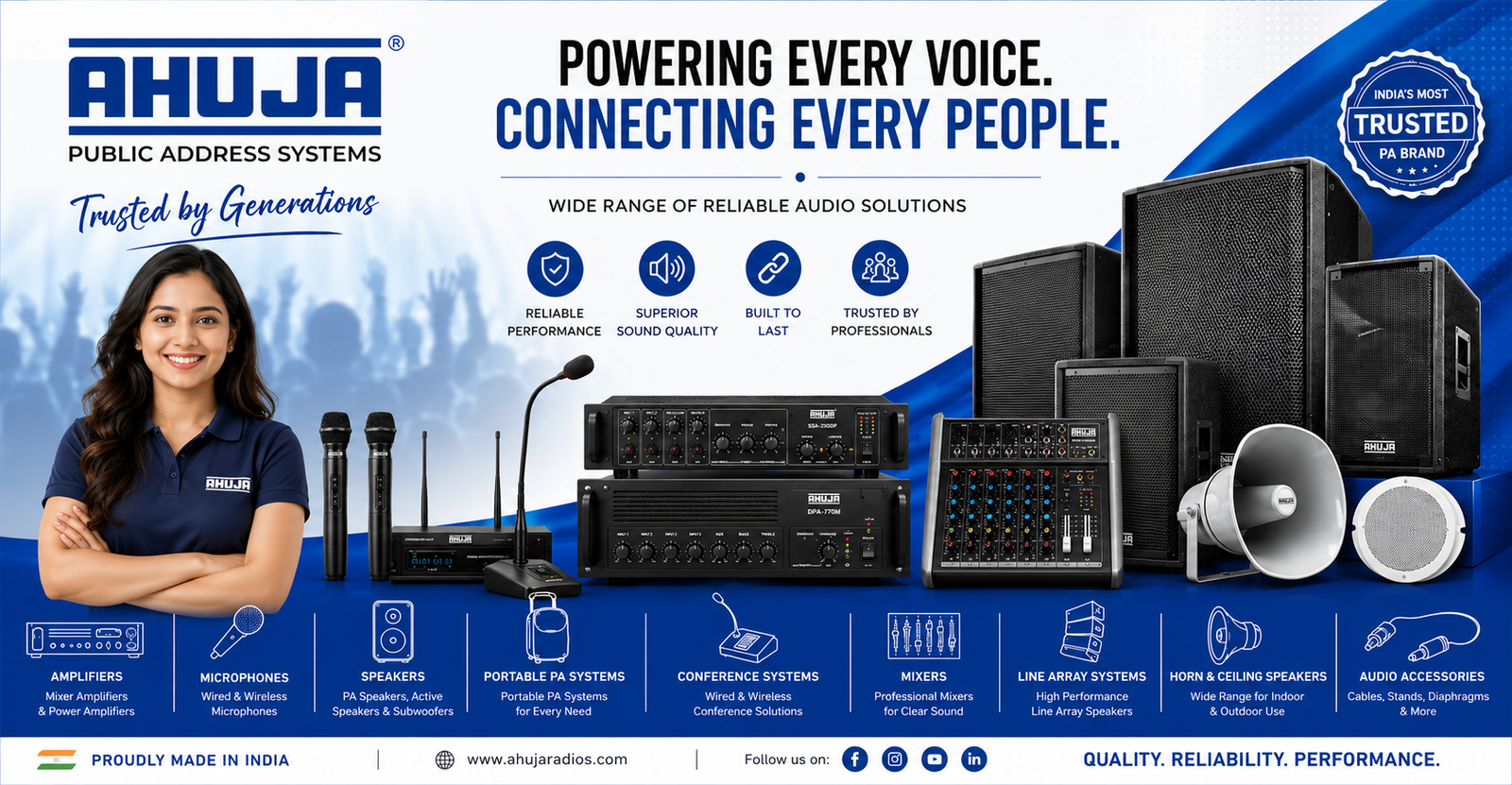
Anyone who has searched for an Ahuja PA system price list quickly discovers that there is no single sheet that answers the question. Ahuja's catalogue spans mixer amplifiers, horn speakers, column speakers, ceiling speakers, and conference and paging systems, and each of these product families can be configured dozens of different ways depending on the venue they are going into. A school corridor paging setup and a multi-hall auditorium sound reinforcement project both use Ahuja equipment, but the bill of materials, the amplifier wattage, the number of zones, and the installation complexity are worlds apart. That is why a genuine price list, in the sense of a fixed catalogue rate card that applies to everyone equally, does not really exist in institutional and B2B audio procurement the way it might for a retail consumer product.
What does exist is a pricing process — a structured way of translating a building's layout, its acoustic requirements, and its budget constraints into a bill of quantities that can then be priced. Understanding that process, rather than hunting for a static number, is what actually helps a buyer get to an accurate figure faster. This article walks through how that process works in practice, what typically changes the final number, how GeM catalogue pricing differs from a direct quote, what a buyer should have ready before asking for pricing, and the mistakes that most commonly lead to inflated or inaccurate estimates.
How Pricing Actually Works: Spec-Driven Quoting
Ahuja PA equipment pricing is fundamentally spec-driven, meaning the final cost is a function of the specification, not a lookup against a single retail tag. The starting point is almost always the amplifier, because the mixer amplifier — whether from the SSA, TZA, SSB, or DP series — determines how many speaker zones can be driven, how much output wattage is available, and what auxiliary inputs and priority-paging features are supported. A basic single-zone SSA-series amplifier serving a handful of ceiling speakers in a small office reception costs a fraction of what a multi-zone DP-series unit with dedicated zone selectors for a five-floor building will cost, even though both are technically "an Ahuja mixer amplifier."
Layered on top of the amplifier choice is the speaker selection. Horn speakers are typically specified for open outdoor areas, factory floors, and playgrounds where projection and durability matter more than tonal finesse. Column speakers suit long corridors, prayer halls, and auditoriums where directional coverage along a horizontal plane is needed. Ceiling speakers are the default for offices, hospitals, classrooms, and retail interiors where the priority is even, unobtrusive coverage rather than throw distance. Each speaker type has a different price point per unit, and the number of speakers required is dictated by the physical area, the ceiling height, and the ambient noise level of the space — not by a fixed ratio anyone can quote without seeing a floor plan.
Cabling, mounting hardware, zone selectors, priority microphone consoles for emergency announcements, and installation labour then sit on top of the equipment cost itself. In a genuine Ahuja PA system price list conversation, this installation and integration layer is often as significant a swing factor as the equipment selection, particularly in older buildings where new conduit runs are required or in multi-storey structures where riser cabling between floors adds meaningfully to labour time.
GeM Catalogue Pricing vs Direct B2B Quotes
Because Sunlite Systems Pvt Ltd is a GeM-registered vendor, one of the most common questions from government and PSU buyers is how GeM catalogue pricing compares with a direct quote obtained through B2B or institutional channels. On GeM, individual Ahuja products are typically listed with catalogue prices that reflect standard configurations at standard quantities, which is useful for straightforward, small-quantity purchases where a department simply needs to replace an amplifier or add a handful of ceiling speakers to an existing system. The GeM price for a listed item is transparent and can be checked directly on the portal, and for single-product orders this is often the fastest route to a purchase order.
Direct B2B quotes come into play once a project moves beyond a single catalogue item into a designed system — for example, a full PA and paging rollout for a new academic block or a multi-zone announcement system for a manufacturing facility. In these cases, pricing is built from a bill of materials that reflects the actual site requirement, and it can include bundling efficiencies, freight consolidation, and installation and commissioning charges that a catalogue listing for an individual product cannot capture. For larger government tenders that are structured as GeM bids with a technical specification document, the underlying pricing logic is closer to the direct-quote model even though the transaction itself happens on the GeM platform, because the tender specification effectively defines a custom bill of materials that then gets priced and submitted as a bid.
The practical takeaway is that GeM catalogue pricing works well for point purchases of standard items, while anything that resembles a "system" — multiple zones, mixed speaker types, custom cabling runs, or commissioning — is better handled as a direct quote request even if the eventual purchase order is still routed through GeM. Buyers who are unsure which route applies to their situation are generally better off describing the actual requirement first and letting the vendor advise on the appropriate pricing route, rather than assuming a catalogue number will scale linearly to a larger project.

How to Request an Accurate Quote
The single biggest lever a buyer has over quote accuracy is the quality of the information given upfront. A request that simply says "PA system for our building" forces the vendor to either ask a long list of follow-up questions or make assumptions that may not hold, both of which slow the process down or introduce errors. A request that instead describes the number of floors, the approximate area per floor, the type of spaces involved (classrooms, corridors, open floor plan, outdoor grounds), and the intended use case (general announcements, background music, emergency paging, or a combination) allows a much tighter first-pass estimate to be produced.
It also helps enormously to state whether the requirement includes installation and cabling or whether it is a supply-only order where the buyer's own electrical contractor will handle the physical work. This single distinction changes the quote structure completely, because labour and site-specific cabling costs are the least standardised part of any PA project. Buyers evaluating Ahuja systems alongside other professional audio brands can find a parallel discussion on how to get a quote for Audac audio systems, which covers similar spec-driven logic for background-music and paging installations in a slightly different product category.
Timelines matter too. If a quote is needed to support a tender submission with a fixed deadline, saying so upfront lets the vendor prioritise accordingly and flag any items that may have longer lead times, rather than discovering a delay only after a formal request for quotation has already been issued.
What to Have Ready Before Asking for Pricing
Buyers who come prepared with a small set of basic facts consistently get faster and more accurate quotes than those who start from scratch in the first conversation. At minimum, it helps to have a rough count and type of spaces to be covered, an approximate site plan or floor layout if one exists, an idea of whether the building is new construction or an existing structure being retrofitted, and clarity on whether this is a one-time institutional purchase, a GeM tender response, or a recurring supply relationship.
- Number of rooms, floors, or zones that need coverage, and their approximate dimensions
- Primary use case — general paging, background music, emergency announcement, or a mix
- Whether existing wiring or speakers are already in place, or this is a fresh installation
- Budget bracket or ceiling, if one has been set internally, even as a rough range
- Procurement route — GeM catalogue purchase, GeM tender, or direct institutional order
None of this needs to be perfectly precise at the enquiry stage. Even approximate numbers are enough for a vendor to produce a first-pass budgetary estimate, which can then be refined into a firm quote once a site visit or a more detailed floor plan is available. The point of preparing this information is to avoid the single most common cause of quote delay, which is a back-and-forth of clarifying questions that could have been answered in the first message.
Common Pricing Mistakes and Misunderstandings
The most frequent misunderstanding is assuming that a price seen for one Ahuja amplifier model applies uniformly across a whole project. Because amplifiers, speakers, accessories, and installation are priced as separate line items that combine differently for every site, a single unit price is only ever a fragment of the real cost picture, not a proxy for it. A related mistake is comparing a bare-supply quote from one vendor against an installed, commissioned quote from another and concluding that one is more expensive, when in fact the second number simply includes work the first one does not.
Another common error is underestimating the effect of building acoustics and layout on speaker count. Two rooms of identical floor area can require a noticeably different number of ceiling speakers if one has a high false ceiling with significant ambient noise and the other is a small, quiet office — yet buyers frequently assume speaker count scales purely with square footage. Similarly, outdoor or semi-outdoor announcement requirements, such as school playgrounds or factory yards, often need horn speakers and higher-output amplification than an equivalent indoor space, which can surprise buyers who priced their project based on an indoor-only reference.
Finally, many first-time institutional buyers underestimate lead time as a pricing factor. Rushed procurement close to a fixed deadline can sometimes affect available configurations or shipping options, and it is worth raising timeline constraints early in the quote conversation rather than after a formal order has already been placed.
Sector-Specific Cost Considerations
In the education sector, PA and paging requirements are usually driven by the number of classrooms, corridors, and outdoor assembly areas across a campus, and the biggest cost variable tends to be the number of independently controllable zones a school wants — for example, being able to page a single wing without disturbing exam halls elsewhere. Healthcare facilities have a related but distinct requirement: paging systems in hospitals often need to integrate with existing announcement protocols and must avoid disrupting patient areas, which can push specification toward more zoned, lower-volume configurations rather than blanket coverage.
Government and corporate office buyers frequently combine a paging backbone with occasional auditorium or conference-hall sound reinforcement, which introduces a second layer of speaker types (column or horn speakers for the hall itself) on top of the ceiling-speaker paging network used for the rest of the building. Manufacturing and industrial sites, by contrast, tend to prioritise horn speakers and higher-output amplifiers because factory floor noise levels are high and safety announcements need to be audible over machinery, which generally pushes both equipment specification and unit count upward compared with an office environment of similar size.
Hospitality and retail buyers most often want background-music capability layered onto a paging system, which changes the mixer amplifier requirement toward models that support multiple simultaneous audio sources with priority override for staff announcements — a configuration that costs differently than a pure paging-only setup even when the physical footprint is identical.
GeM and Institutional Pricing in Practice
For government departments, PSUs, and other institutional buyers who must procure through GeM, the practical pricing angle is less about finding the lowest catalogue number and more about matching the technical specification in the tender to a bill of materials that actually satisfies the stated requirement without over- or under-specifying it. A tender that asks for paging coverage across a defined number of rooms with minimum wattage and speaker-type requirements effectively writes its own bill of materials, and the resulting GeM bid price reflects that specification directly. Buyers drafting such tenders benefit from involving an experienced vendor early, since a specification that is technically accurate but unrealistic for the actual space can lead to an inflated bid or, conversely, a specification that under-serves the space can lead to complaints after installation.
Institutional buyers outside the formal GeM tender process — for instance, a private hospital trust or a corporate facilities team — generally have more flexibility to iterate on the specification before finalising an order, which often results in a better cost-to-coverage outcome because the bill of materials can be adjusted after an initial site assessment rather than being locked in at the tender-drafting stage. For readers evaluating a related large-venue AV budget alongside PA requirements, the discussion of the latest Barco ClickShare price guide for India covers a comparable institutional procurement logic for conferencing and collaboration equipment.

Frequently Asked Questions
Is there a fixed Ahuja PA system price list available online?
Individual Ahuja products carry listed prices on the GeM portal and through authorised dealer catalogues, but a complete system price depends on the specific mix of amplifiers, speakers, cabling, and installation work required for a given site, so a single universal price list does not capture real project costs.
What is the single biggest factor that changes the quote?
The amplifier series and the number of zones it needs to drive is usually the largest single cost driver, followed closely by the total speaker count and type, which is dictated by the physical layout and acoustic character of the space being covered.
Does buying through GeM guarantee a lower price than a direct quote?
Not necessarily. GeM catalogue pricing is efficient for standard, single-item purchases, but a properly scoped direct quote for a full system can be more cost-effective once bundling, freight, and installation are accounted for as a package rather than priced item by item.
Can a quote be provided without a site visit?
A budgetary estimate can usually be produced from a floor plan and a description of the space, but a firm, final quote for a multi-zone installation is more reliable once a site visit or detailed drawing confirms cabling routes and speaker placement.
How long does it typically take to get a quote after enquiry?
Straightforward single-product GeM purchases can be priced almost immediately from the catalogue, while a full system quote depends on how quickly the buyer can supply site details, with more complete initial information leading to a faster turnaround.
Closing Summary
Getting to an accurate number for an Ahuja PA installation is less about finding a magic price sheet and more about supplying the right information early — the spaces involved, the intended use, the installation scope, and the procurement route — so that a genuine bill of materials can be built and priced correctly the first time. Buyers who understand the difference between GeM catalogue pricing and a direct system quote, and who come prepared with basic site information, consistently get to a workable number faster and with fewer surprises later. For a broader look at how a similar system, the Crestron automation system price list, is quoted for AV control projects, the logic of spec-driven pricing carries over closely despite the very different product category. Sunlite Systems Pvt Ltd works across GeM tenders, direct institutional supply, and retail through the Sunlite Systems Online Store, and also operates as Sunlite Systems India and Sunlite Systems Pvt Ltd for buyers researching the wider company profile beyond a single product line, while readers exploring related décor and value-retail sourcing sometimes also browse our Rudraksh India store as part of a broader institutional buying exercise.
A Step-by-Step Way to Request an Accurate Quote
Most delays in getting a usable Ahuja PA system price list happen not because a supplier is slow, but because the request itself is loosely framed. A vague enquiry gets a vague, indicative response; a structured one gets a number you can actually plan a purchase around.
- Start with the use case, not the catalogue. Decide whether the requirement is background paging, emergency announcement, a conference/meeting system, or a mix, before browsing amplifier or speaker models.
- Fix the coverage area in writing. A one-line description like "ground floor plus two upper floors, corridors and one assembly hall" gives a supplier enough to propose horn, column, or ceiling speaker mixes rather than guessing at quantities.
- Ask for the quote in zones, not as a lump sum. A zone-wise breakdown makes it obvious where the budget is going and lets you trim or phase specific zones without re-quoting the whole project.
- Request alternates at two price points. One configuration built around standard mixer amplifiers and speakers, and a second with added features such as digital selectors or ambient noise sensing.
- Get installation and cabling priced separately from equipment. Labour, conduiting, and speaker wire runs can rival equipment cost on larger campuses.
- Confirm the warranty and service turnaround before accepting the number. Two quotes with identical equipment can differ meaningfully once one includes on-site service visits and the other only offers carry-in support.
Following this order does not lengthen the process. It usually shortens it, because the supplier is not sending back three revised quotes to account for details you didn't specify the first time.
Budget Planning Beyond the Quoted Price
The number on a quotation is the entry cost, not the full cost of running a PA system over its working life. For institutions, factories, and government buildings where the system runs daily for years, a few recurring items deserve a place in the budget conversation from day one, not as a surprise later.
Cabling and infrastructure are the most commonly under-budgeted item. Horn and column speakers strung across a large campus or factory floor need conduit, junction boxes, and often trenching if runs cross open ground.
Power backup is the second item. A PA system that must remain functional during a power cut needs to be sized into any UPS or backup power the building already has, or budgeted as an addition if it does not.
Serviceability and spares are the third and most overlooked item. Mixer amplifiers, horn speakers, and volume controllers degrade with continuous use, particularly in outdoor or high-humidity zones. Budgeting for a routine service visit once or twice a year, and keeping a small stock of common spares, avoids a scenario where a single failed zone takes weeks to fix.
Finally, expansion headroom belongs in the initial plan even if it isn't purchased initially. A mixer amplifier and cabling run sized with a few spare zones costs comparatively little to include at installation time, but retrofitting that capacity later is materially larger.
Does the price list change if I need the system to integrate with an existing fire alarm or emergency system?
Yes, integration requirements typically add both equipment and configuration cost. This should be scoped and quoted as its own line item rather than assumed to be included.
Can I get a lower price by buying components separately instead of as a system?
It is possible, but it shifts the compatibility and warranty risk onto the buyer. Buying components separately from multiple sources to shave cost can create mismatches that are more expensive to troubleshoot later than the amount saved upfront.
Explore More — Sunlite Systems Network
Ready for a Ahuja Quote?
Sunlite Systems Pvt Ltd is a GeM-registered, authorized Ahuja channel partner across India.
Contact Us Now