 Sunlite Systems Pvt. Ltd.



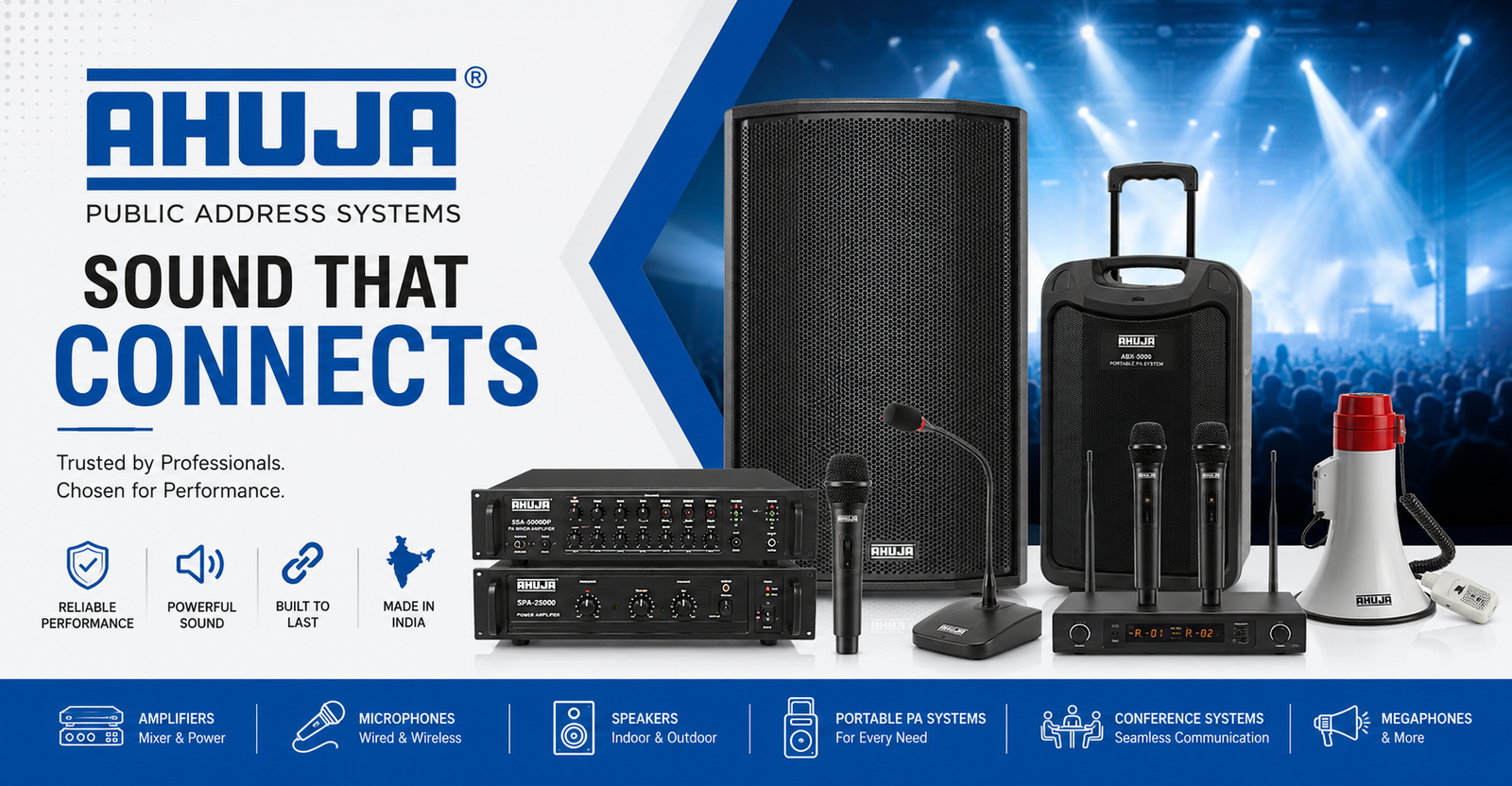



Ahuja Public Address Setup Services: How Professional PA Installation Actually Works
Why Professional PA Installation Matters More Than the Hardware Itself
A public address system is only as good as the installation behind it. Organisations across India routinely buy well-specified Ahuja mixer amplifiers, horn speakers, column arrays, and paging consoles, only to find that coverage is patchy, speech is unintelligible in certain zones, or the paging console cannot reliably reach every floor of a building. The electronics were never the problem — the layout, cable routing, zoning, and tuning were. This is exactly why Ahuja public address setup services have become a distinct and valued category of work in their own right, separate from simply purchasing equipment. A PA system is an infrastructure project, not a plug-and-play appliance, and it needs to be treated that way from the first site visit to the final commissioning sign-off.
This matters even more in India's diverse building stock — schools with open courtyards, factories with high ambient noise, government offices with long corridors and multiple wings, hospitals with sound-sensitive wards, and hotels with banquet halls that double as conference venues. Each of these environments absorbs and reflects sound differently, and each has different intelligibility requirements. A horn speaker that works perfectly on an open factory floor will sound harsh and overbearing in a hospital corridor. A ceiling speaker density that is right for an office will leave a school playground under-covered. Getting this right is precisely the job of a competent PA installation team, and it is why the setup service itself deserves as much attention as the choice of amplifier or speaker model.
What Ahuja Public Address Setup Services Actually Involve
At its core, a proper PA installation project covers five linked activities: acoustic and coverage planning, cable and conduit routing, equipment mounting and termination, zone configuration, and system tuning and testing. Coverage planning decides how many horn, column, or ceiling speakers are needed and where they should sit so that speech remains intelligible at the farthest point from the source without being deafening near it. Cable routing determines whether speaker lines run through existing conduit, need fresh conduit, or can be surface-mounted discreetly along cable trays — a decision that affects both cost and how invasive the work is to an occupied building.
Equipment mounting covers physically fixing horn speakers to poles or walls at the correct angle and height, wall- or ceiling-mounting column and ceiling speakers, and racking the mixer amplifier, power supplies, and paging microphone console in a ventilated equipment room or cabinet. Zone configuration is the software and wiring layer that decides which speaker groups can be addressed independently — so that an announcement to the accounts department does not have to be heard in the boardroom, or an emergency evacuation message can be broadcast to every zone simultaneously while background music plays selectively elsewhere during normal hours. Tuning and testing is the final and most frequently skipped step: walking every covered zone with the system live, adjusting amplifier gain and equalisation, and confirming that paging, background music, and emergency override all function as intended before handover.
Genuine Ahuja public address setup services also include documentation — as-built wiring diagrams, a zone map, and a simple operating note for whoever will run the paging console day to day, whether that is a school office administrator, a factory shift supervisor, or a hotel front desk executive. Without this handover documentation, even a well-installed system becomes hard to maintain or expand later, because nobody remembers which cable goes where.
How to Choose the Right PA Installer or Integrator
The single biggest predictor of a successful PA installation is not the brand of amplifier chosen but the competence of the installation team. When evaluating an installer, ask to see completed projects of a similar scale and building type — a residential society intercom installer is not automatically qualified to wire a multi-storey hospital paging system, and a home-theatre installer may have never worked with 70V/100V constant-voltage speaker lines, which is the standard wiring topology for commercial PA systems and behaves very differently from low-impedance home audio wiring.
A competent installer should be comfortable discussing constant-voltage line loss calculations, should be able to explain how they plan to route cable without unnecessary wall-chasing in a finished building, and should ask about the acoustic character of your space before quoting speaker counts. If a vendor quotes a PA system without ever visiting the site or asking for a floor plan, that is a warning sign. Similarly, ask who will actually be on the installation crew — a company with in-house trained technicians tends to deliver more consistent results than one that outsources every job to a different local contractor. Finally, confirm whether the installer offers post-installation support: PA systems need periodic checks, and an installer who disappears after handover leaves you without recourse when a speaker line develops a fault two years later.
It is also worth asking how the installer handles multi-brand environments. Many institutions already have some PA infrastructure, paging phones, or an existing fire alarm interface, and a good integrator will explain how new Ahuja equipment will interface with what already exists rather than proposing to rip everything out.

Site Prep and Planning Before Installation Begins
Good PA outcomes start well before any cable is pulled. The planning phase should include a written floor plan review, a walk-through to identify obstructions such as false ceilings, existing conduit runs, and structural beams, and a discussion of electrical points — PA amplifiers and paging consoles need clean, ideally UPS-backed power, especially where the system doubles as an emergency notification tool. Where a building is under construction or undergoing renovation, this is the ideal time to lay conduit for speaker cabling before walls and ceilings are closed up, which saves significant cost and disruption compared to retrofitting into a finished space.
Planning should also cover ambient noise assessment. A factory floor with heavy machinery needs a very different speaker sound pressure level and horn placement strategy than a quiet office corridor. Similarly, outdoor zones — parking areas, playgrounds, factory yards — need weatherproof horn speakers and cable glanding that will survive monsoon conditions, which is a real consideration across most of India. Finally, site prep should settle who owns which part of the project: does the installer supply and terminate conduit, or does the client's electrical contractor handle first-fix wiring with the PA integrator only doing second-fix and commissioning? Clarifying this upfront avoids disputes and delays once work begins.
Step-by-Step: What to Expect During Installation
A well-run PA installation typically proceeds through a recognisable sequence. First comes the site survey and design sign-off, where the installer presents a zone map and speaker layout for approval. Second is first-fix cabling, where speaker lines and power runs are pulled through conduit or trays, generally the most disruptive phase since it may involve some ceiling access or wall work. Third is equipment mounting — horn speakers go up on poles or brackets, ceiling speakers are fitted into tiles, and the amplifier rack is installed in its equipment room.
Fourth is termination and labelling, where every speaker line is connected, tested for continuity, and clearly labelled at both ends so that future maintenance does not require guesswork. Fifth is system configuration — programming zones into the mixer amplifier or paging console, setting priority levels so that emergency announcements can override background music or floor-level paging, and configuring any scheduled functions such as bell timings in a school. Sixth is live testing, where the installer walks every zone with test announcements and background music playing to confirm coverage and intelligibility, adjusting amplifier gain and speaker positioning where needed. The final step is handover — a demonstration to the client's operating staff, delivery of as-built documentation, and a written commissioning report confirming the system meets the agreed design.
Throughout this process, a professional installer should keep the client informed of progress, flag any deviations from the original plan immediately rather than at the end, and avoid leaving work areas in a state that disrupts daily operations any longer than necessary, particularly in occupied schools, hospitals, and offices.
Common Mistakes in PA Installation and How to Avoid Them
The most frequent installation mistake is under-speccing coverage to save cost, resulting in dead zones where announcements simply cannot be heard — a serious problem when the PA system is also the building's emergency notification tool. The second common mistake is poor cable practice: running speaker lines alongside high-voltage power cables without adequate separation, which introduces audible hum, or using undersized cable gauge over long constant-voltage runs, which causes signal loss and uneven volume between near and far speakers.
A third mistake is skipping the tuning and walk-test phase entirely, treating installation as complete once cables are connected, without ever confirming real-world intelligibility. A fourth is neglecting zoning requirements — wiring an entire building as a single zone when different departments or floors genuinely need independent control leads to constant complaints and manual workarounds later. A fifth, easy to overlook, is failing to weatherproof outdoor horn speakers and junction boxes properly, leading to corrosion and failures within a single monsoon season. Each of these is avoidable with a planning-first approach and an installer who treats the walk-test and documentation stages as mandatory rather than optional.
Sector Scenario: Installing a Campus-Wide PA System for a School
Consider a mid-sized school with a main academic block, a separate primary wing, an outdoor playground, and an assembly hall. The installation team begins by mapping bell-timing and announcement needs separately from assembly-hall requirements, since the hall needs higher-quality sound reinforcement for functions and speeches while classroom corridors need simple, reliable paging and bell tones. Horn speakers are placed at the playground boundary, angled to cover the open area without excessive spill into neighbouring classrooms. Ceiling speakers run through classroom corridors on a separate zone from the hall's column speakers, so that a school-wide bell does not interrupt a hall event and vice versa.
The paging console is placed at the school office, with priority override wired so that the principal's office can interrupt any zone in an emergency. Cabling is routed through existing ceiling voids in the older block and through fresh conduit in a newer annexe under construction, coordinated with the electrical contractor's first-fix schedule. After installation, the team conducts a walk test during a normal school day to confirm bell audibility across every classroom and adjusts amplifier gain accordingly before final handover and staff training on the paging console.
GeM Tenders and Institutional PA Installation Projects
Government departments, PSUs, and public educational institutions frequently procure PA systems through GeM tenders, and installation is typically bundled into the tender scope alongside supply. For these projects, documentation discipline matters even more: tender-based installations usually require a formal commissioning report, photographic evidence of installed equipment, and sign-off from the department's technical representative before payment is released. As a GeM-registered vendor, Sunlite Systems Pvt Ltd approaches these institutional installations with the same site-survey-first, zone-planned methodology described above, adapted to the compliance and reporting expectations of government procurement — including adherence to tender-specified speaker counts, cable specifications, and completion timelines. Institutional buyers evaluating a GeM vendor for PA installation should specifically ask how the vendor handles post-installation compliance documentation, since this is often where public-sector projects stall at the final payment stage.

Frequently Asked Questions
How long does a typical PA installation take? For a single building of moderate size, installation commonly takes a few days to two weeks depending on whether conduit already exists or needs to be laid, and how many zones are being configured.
Can an existing PA system be expanded rather than replaced? Yes — in most cases, additional zones or speakers can be added to an existing constant-voltage PA backbone provided the amplifier has spare capacity, which a site survey will confirm.
Do outdoor areas need different equipment than indoor zones? Yes, outdoor horn speakers and junction boxes need weatherproof ratings and careful cable glanding to survive monsoon exposure, which should be specified at the design stage.
Is a PA system installation covered under warranty after handover? Reputable installers provide a workmanship warranty on installation separate from the manufacturer's product warranty, and it is worth confirming both in writing before work begins.
Can the same installer support us after installation for maintenance? Ask this before signing — ongoing support for adjustments, fault-finding, and future expansion is a meaningful part of the value an integrator provides beyond day-one installation.
Closing Summary
A public address system's real performance is decided during installation, not at the time of purchase. Reliable Ahuja public address setup services combine careful site planning, correct cable and zoning practice, disciplined step-by-step execution, and a genuine walk-test-and-tune phase before handover — whether the project is a single school hall, a multi-building corporate campus, or a government office procured through GeM. Organisations planning a new PA installation or an upgrade to an existing one can review further product options through Sunlite Systems Online Store, explore integration options for wireless collaboration and boardroom AV described in our Cisco meeting room installation guide, or compare background-music and PA integration approaches in our Audac audio integration guide. For broader company information visit Sunlite Systems Pvt Ltd or Sunlite Systems India, and for other authorised Sunlite retail offerings see our Rudraksh India store.
Cabling and Acoustic Planning Behind a Reliable PA Installation
Most complaints about a public address system have nothing to do with the amplifier or speaker model chosen — they come down to how the cabling was run and how the acoustics of the space were treated before a single speaker went on the wall. Anyone offering genuine Ahuja public address setup services should be able to explain, in plain terms, why these two factors matter more than the spec sheet.
Start with cabling. PA systems, particularly the 70V/100V constant-voltage lines common in Ahuja mixer amplifier setups, are designed to carry audio over long distances with minimal signal loss, but only if the wire gauge is matched to the run length and total speaker load. A cable that is too thin for the distance introduces voltage drop, which shows up as speakers at the far end of a corridor or campus sounding noticeably quieter than those near the amplifier rack. A proper installer will size the cable to the total wattage on that zone and the distance it has to travel, and will keep audio cable separated from mains electrical runs to avoid hum and interference.
Acoustics is the second, less obvious factor. A horn speaker that is perfectly adequate outdoors in an open yard can produce unintelligible echo in an enclosed hall with hard, reflective surfaces. Ceiling speakers in a room with a low, hard ceiling and no soft furnishings will often sound harsh and cause announcements to blur together. This is why site acoustic behaviour — not just square footage — should shape speaker selection, placement height, and angle.
Signs Your PA Installation Was Not Done Properly
- Uneven volume across zones — some speakers noticeably louder or quieter than others on the same amplifier line, usually pointing to incorrect cable gauge or an unbalanced zone design.
- Persistent hum or buzz when the amplifier is idle, which almost always traces back to audio cable run alongside electrical wiring, or a poor earthing connection at the rack.
- Announcements that echo or blur in enclosed spaces, indicating speaker type or placement was copied from a generic template rather than assessed for that room's acoustics.
- No documented zone map or wiring diagram left with the client — if a fault occurs later, nobody can trace which speaker belongs to which line.
- Exposed or unsecured cable runs near walkways or ceilings without proper clips or conduit, an early sign the rest of the install was rushed.
Post-Installation Support and AMC Planning
A PA system is infrastructure expected to work every day, often for safety alerts that cannot fail silently. A well-run installer will walk the client through a basic operating checklist before leaving: how to check amplifier status lights, identify a fault's zone, and who to call if a speaker goes silent.
An annual maintenance contract (AMC) is worth planning from day one. A structured AMC typically covers periodic checks of amplifier output levels across zones, inspection of speaker connections and cable terminations, cleaning of ventilation on amplifier racks, and testing of backup paging in institutions where continuity matters, such as schools, hospitals, and manufacturing floors. For GeM buyers, a documented post-installation support plan is also useful at the tender-compliance stage.
Practically, this means agreeing upfront on visit frequency, response time for fault calls, and what is covered versus billed separately. Sites with more demanding uptime needs — a hospital paging system or factory safety announcement system — should have a shorter response-time commitment than a retail showroom's background paging.
Explore More — Sunlite Systems Network
Ready to Install Ahuja Equipment?
Sunlite Systems Pvt Ltd is a GeM-registered, authorized Ahuja installation partner across India.
Contact Us Now